



CKBlog: The Market
Thursday, October 29, 2026
The Yield on 10-Year US Treasury Notes Tops 5%
by Steve Haberstroh, Partner
A Few Things You Should Know
Interest Rates vs. Coupons vs. Yields (A Quick Cheat Sheet)
- Interest Rate: The price an entity pays for borrowing money. Usually expressed as a percentage. The borrower pays the interest. The lender receives the interest.
- Example: The US Treasury just issued new 10-year notes carrying a 5% interest rate.
Coupon: The periodic interest payment that a borrower (bond issuer) promises to pay until the bond matures. Usually fixed and can be expressed in dollar terms.
- Example: A $1,000 US Treasury 10-year note currently pays $50 in coupon payments per year.
Yield: Income generated from an investment. In bonds, this is derived from coupon payments paid to bond holders. Usually expressed in percentage terms.
Example: An investor purchases a US Treasury 10-year note for $1,000. They are entitled to receive $50 in coupon payments per year. Therefore, the investor earns a 5% yield ($50/$1000 = 5%). If they purchased that same bond but at a lower price of $800, the bond would carry a higher yield even though the coupon payment doesn’t change ($50/$800 = 6.25%).
Higher Yields Have Gone Global
It’s not just us. Higher yields have been a recent theme for the largest developed economies in the world.
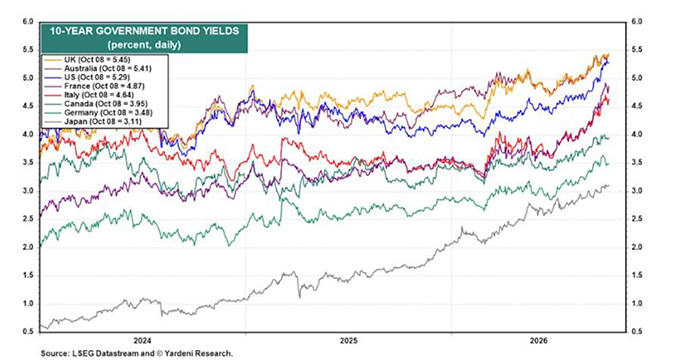
Source: Yahoo Finance Article: Bond Yields Are Surging Worldwide- Chart of the Day
Four Dynamics Influencing the Rise
We’d like to offer four likely dynamics responsible for the trajectory of the rise. While US focused, these themes can be applied to most developed countries:
- Inflation: Rising prices have been the most widely covered influence on global markets in the post-pandemic period. The Consumer Price Index (CPI) reached a four-decade high of 9.1% in 2022. Central banks across the globe reacted by raising their benchmark interest rates to try to bring inflation back under relative control. The War in Iran, however, has caused prices to spike again, raising the expectations for yet another rate hiking cycle. The following chart depicts the CPI going back 10 years:
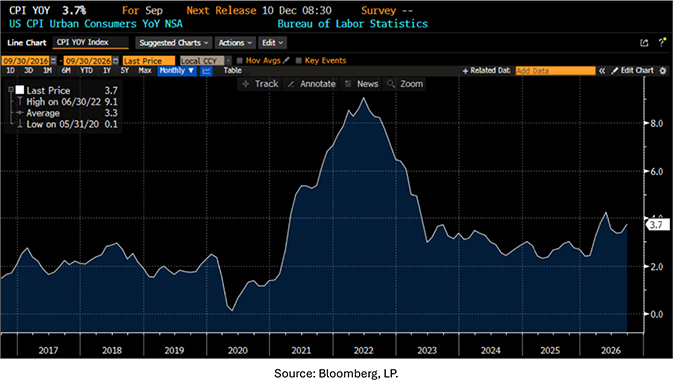 While inflation is dramatically lower than the highs in 2022, the slight uptick to the right side of the chart may be influencing the rate curve.
- Increased concerns regarding fiscal health: It is no secret that the US and many other developed countries are running sizable fiscal deficits. The US federal government spends more than it collects in tax revenue. Therefore, to fund the excess government spending it must borrow money. As borrowing costs grow, lenders will require a higher interest rate to compensate them for the increased (perceived) risk of lending funds to the US government. If they must sweeten the deal to get buyers, yields will continue to trend higher.
- There is more competition: Fixed income and bond investors have many options to consider when choosing where to put their next dollar to work. Recently, the largest companies in the world have flooded the market with new debt issuance to fund the buildout of Artificial Intelligence (AI). As an example, investors now can weigh whether they would like to lend money for a 10-year term to Amazon or the US government at very similar rates. If investors are more concerned about the fiscal health of the US versus, say, Amazon, they may demand higher coupon rates from the US government. This would be to compensate them for the increase in perceived risk over the 10-year term.
- Interest rates tend to rise when the economy is strong and expected to grow: This may be counter intuitive. During periods of economic strength and expansion, interest rates on long-term debt tend to rise. Why? Competition with stocks for that next investment dollar. The US economy, as measured by nominal GDP growth, is inarguably strong. The following chart depicts this. The green bars represent quarter-over-quarter GDP growth, and the red bars illustrate quarter-over-quarter periods of contraction (when the economy shrinks).
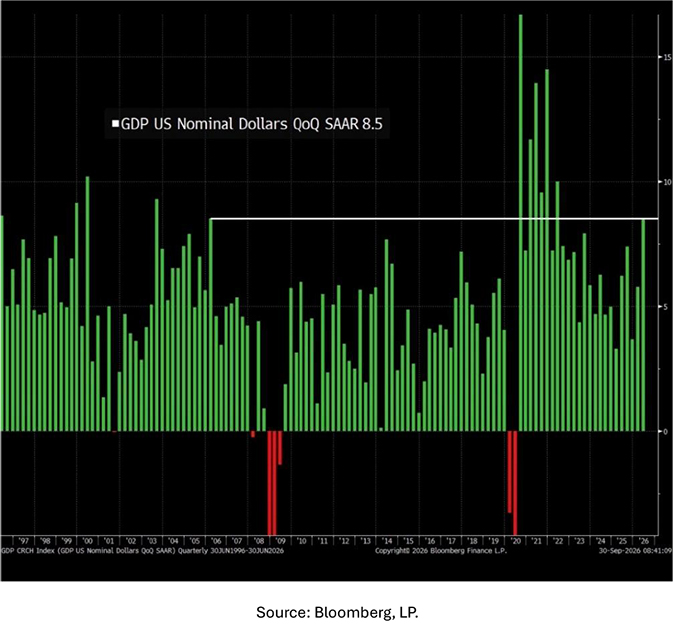 Investors who are bullish about the economy historically tend to favor stocks. If investors continue to choose stocks, there are less dollars available to buy bonds. Interest rates usually need to rise to entice investors to sell their stocks and rotate into bonds. If you expected the economy and therefore the underlying earnings of the S&P 500 to grow double digits, why park your money with the US government and lock in a 5% return? Some may require a 6%, 7% or even 10% return depending on their risk appetite and what they are able to find in the market.
Despite Their Rise, Yields Remain Below Historical Averages
Younger generations who were alive during the 1970s and 1980s may think 5% yields on the US 10-year note are abnormally high. Turns out, a 5% yield is below its historical average. As you can see from the next graph, the average yield going back to 1960 is 5.79%!
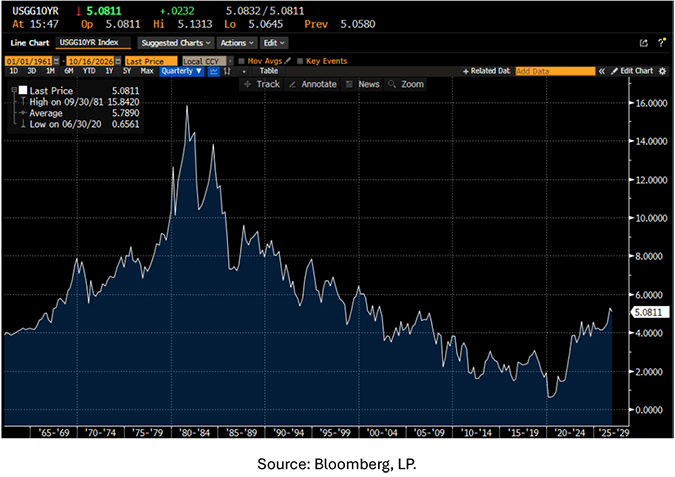
Today’s yields may be closer to “normal” than you think. With this context, are you still concerned about yields reaching 5% and possibly moving higher?
Higher Yields Can Be a Good Thing
During the 2010s the US 10-year yield averaged 2.40% and the yield on the 3-month treasury bill averaged 0.56%. Investors in bonds simply were not being paid well. For strong returns, investors relied on stocks to do most of the work (fortunately, they did).
Fast forward to today where you can earn over 3.5% on your money market fund and pocket roughly 5% per year from 10-year US government paper. For savers and investors building out diversified portfolios, treasury bonds now offer a more attractive return stream than over the last decade. In turn, your stock portfolio may not have to work as hard to achieve your objectives.
How Might Higher Interest Rates Impact Stocks?
The two most probable impacts are:
- Bonds are officially a fierce competitor to stocks again.
- Lower stock valuations (assuming no change in earnings growth).
We’ve already covered the first one above. If investors allocate more of their portfolio to bonds, there’s less demand for stocks. At the end of the day, stock prices move based on the demand (and supply) for their shares. If bonds are more attractive today due to higher yields and lower prices, stock prices would need to pull back to remain attractive and win that next investment dollar.
The second one requires a bit more analysis and involves the time value of money. Say you are considering investing in a company for 10 years. An astute investor might attempt to project what that company might earn (focusing on projected free cash flow as an example) each year for the next 10 years. If the expected cumulative cash flow is greater than the dollar amount invested today, it might indicate an attractive investment opportunity.
However, a dollar today is worth more than a dollar tomorrow (or 10 years from now) due to the erosion caused by inflation. An astute investor would be wise to reduce those future profits by a discount rate which considers estimated inflation rates. The 3-month treasury bill yield is often used as this discount rate. That discounted cash flow needs to be appreciably more than what you can earn on US treasuries, otherwise why take the extra risk?
As interest rates rise, an investor will require a better deal on the bond investment at hand. When considering stocks, that investor will require a lower entry point before submitting the buy trade.
Given everything we’ve outlined above, it is understandable that stock markets were weak during the September spike in global yields. Investors were taken a bit off-guard and re-calibrated the risk versus reward between stocks and bonds.
Conclusion
We do not view the increase in interest rates as perilous on its own and remind investors that 5% yields on US 10-year bonds are more normal than not. If rates continue to surge, it will not be uncharted territory for our CEO, Charles Haberstroh. Early in his professional career, he lived through prolonged periods of higher interest rates both during the late 1970s and early 1980s in the US as well as in Brazil where short-term inflation reached 3% per day in the mid-1980s. He often reminds our team with real world examples of just how difficult it is to reduce inflation and thus interest rates.
The rise in interest rates had a negative impact on many asset classes in September. While we will continue to monitor the developments, nothing we have seen thus far has caused us to dramatically alter our strategy. Perhaps, however, the dislocation will present us with attractive opportunities that did not exist when global interest rates remained stubbornly close to zero for most of the last decade.
Steve Haberstroh and The CastleKeep Team
[PDF if this entry] The Yield on 10-Year US Treasury Notes Tops 5%
Important Discolures:
The information presented is provided for general informational and educational purposes only and should not be construed as personalized investment advice or a recommendation to buy or sell any particular security or investment product. The views expressed reflect the opinions of CastleKeep Investment Advisors, LLC as of the date of publication and are subject to change without notice.
Certain statements reflect forward-looking expectations, estimates, or projections regarding economic conditions, interest rates, financial markets, and investment performance. Such statements are inherently uncertain, and actual outcomes may differ materially from those anticipated. There can be no assurance that any forecasts or expectations will be realized.
Investing involves risk, including the potential loss of principal. Fixed-income investments are subject to interest rate risk, and their market values generally decline when interest rates rise. Although U.S. Treasury securities are backed by the full faith and credit of the U.S. government with respect to timely payment of principal and interest, their market values may fluctuate, and investors who sell prior to maturity may experience losses.
Historical market trends and past performance are not guarantees of future results. References to market indices, economic data, and third-party information are provided for illustrative purposes. While such information is believed to be reliable, CastleKeep makes no representation or warranty regarding its accuracy or completeness.
Registration with the SEC should not be construed as an endorsement or an indicator of investment skill, acumen or experience.